
GRADUATE SEMINAR & RESEARCHPPGEC UFV Guidelines
Academic Regulations, Evaluation Criteria, Milestones, and Presentation Directives.
Universidade Federal de Viçosa
Prof. Coord. José Maria Franco de Carvalho
PPGEC / UFV — Institutional Context & Academic Impact


Grade 6
Geotechnics
Spatial Information
Sanitary & Environmental
Construction Engineering
Social Impact, Innovation & Employability
- Public Policies & Territory: Strategic national projects (RADIS, AMARIS, DNIT/BIM) for land titling, Amazonian family mapping, and infrastructure modernization.
- SDGs & Climate Resilience: AI-based urban risk mapping, eco-efficient cement composites, and microalgae biorefineries.
- Alumni Projection: 92% of Ph.D. graduates serve as faculty/researchers in public higher education institutions nationwide and abroad.
Course Nature & Mandatory Requirements
Nature & Credits
- Core Objective: Produce and defend the formal research project throughout the semester.
-
Academic Structure: Internal protocol directly linked to a regular course (
CIV 797). - Grading & Workload: Attributes 1 academic credit and a formal grade.
Defense Timeline
- Master's Degree (M.Sc.): Prepare and defend proposal by the end of the 2nd semester.
- Doctoral Degree (Ph.D.): Prepare and defend proposal by the end of the 3rd semester.
Mandatory Protocol
- SISPPG Registration: Advisor must register the approved project in SISPPG within the 1st month of the following semester.
- SIA Presentation: Mandatory presentation of the approved project in UFV's SIA event.
- Integration Seminar: Present approved project in the official PPGEC Integration Seminar (SI2026).


Qualitative Criteria & Scoring Distribution Rubric
Qualitative Expectations
Scope & Rigor
Project Feasibility
Defense Performance
100 Points Evaluation Rubric
Project Written Structure
Introduction
Contextualize problem, novelty, and relevance backed by up-to-date references.
Review & Hypotheses
Synthesize state-of-the-art literature and explicitly formulate research hypothesis(es).
Objectives & Methods
Align general/specific objectives directly with material & experimental methods.
Planning & References
Physical and financial schedules, expected impacts, and ABNT formatted references.
Defense Presentation Structure
Sequence of Slides
- Brief Problem Description: Concise context (avoid long literature reviews).
- Hypotheses & Objectives: Direct scientific proposition.
- Methodology: Detailed step-by-step procedures.
- Expected Results & Timeline: Deliverables and schedule.
25 - 35
MINUTESVisual & Technical Slide Rules
Typography & Numbers
Always insert slide numbers. Use font size $\ge 18\text{pt}$ for body text. Keep titles concise.
Color Contrast
Choose title/text colors carefully. Avoid high-contrast bright red or pure yellow text for readability.
Content Synthesis
Avoid text paragraphs — use telegraphic text. Flowcharts and figures are far better than explanatory text.
Font Hierarchy Reference
Font Size 28pt — Main Titles & Headers
Font Size 20pt — Subtitles & Essential Bullet Points
Font Size 16pt — Secondary Information & Captions (Use $\ge 18\text{pt}$ when possible)
Diagrams & Flowcharts in Defense Slides
Why Flowcharts Over Plain Text?
- Cognitive Efficiency: Visual workflows allow examiners to grasp complex experimental steps instantaneously during a short talk.
- Structured Logic: Clear directional connectors demonstrate exact procedural sequence and analytical dependencies.
- Design Tip: Keep block shapes uniform, minimize text density inside nodes, and use color coding to group experimental phases.
Explore Real Diagram Examples
Navigate vertically down to inspect four benchmark diagram implementations from Civil Engineering research projects.
Complete Cement Production and Characterization
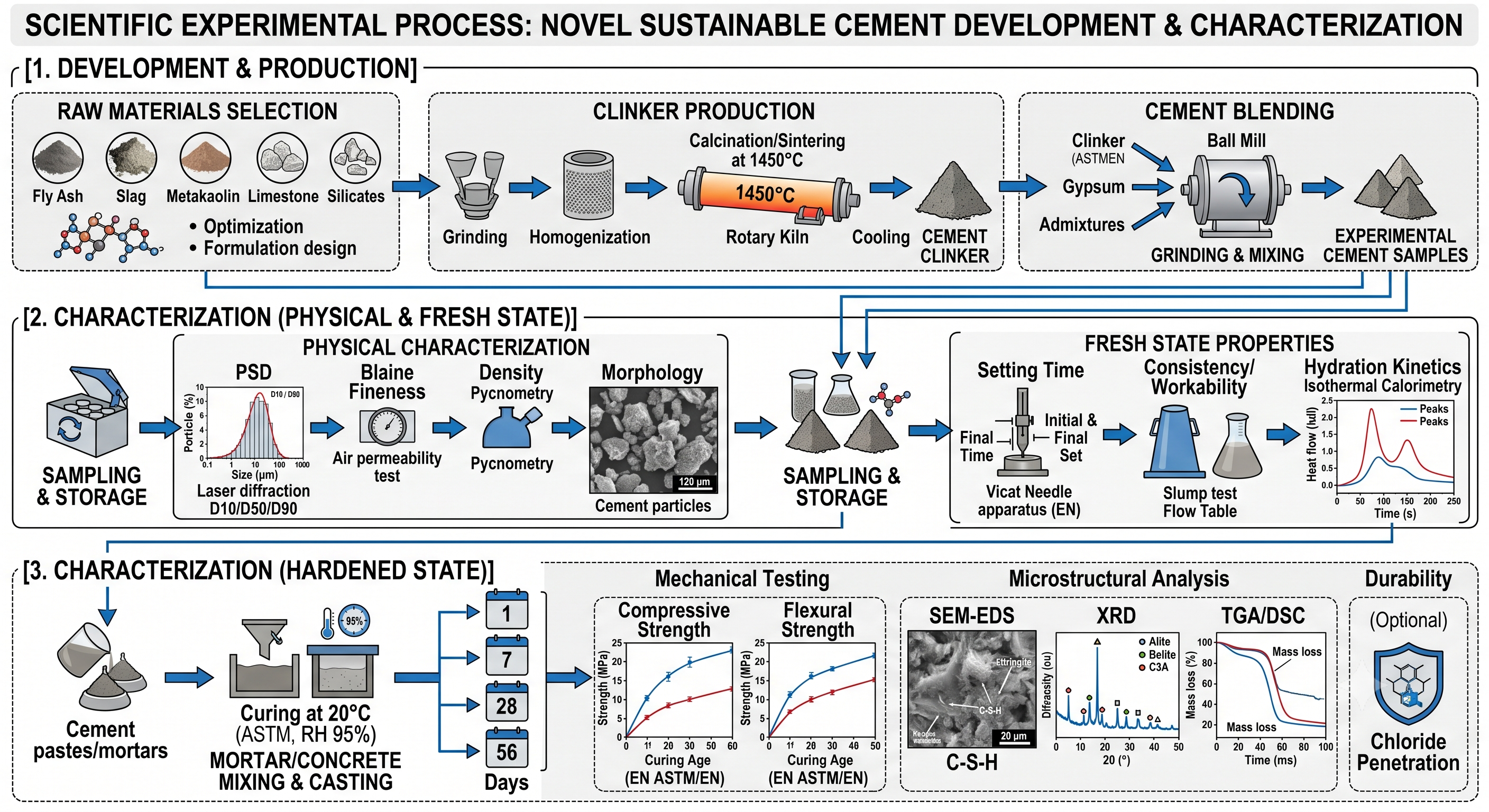
Some Tips...
- • Clear linear phase separation (Input $\rightarrow$ Process $\rightarrow$ Output).
- • Highlights physical components and monitoring parameters directly.
- • Minimalist color scheme avoids visual clutter during defense.
Sample Preparation, Test and Analysis
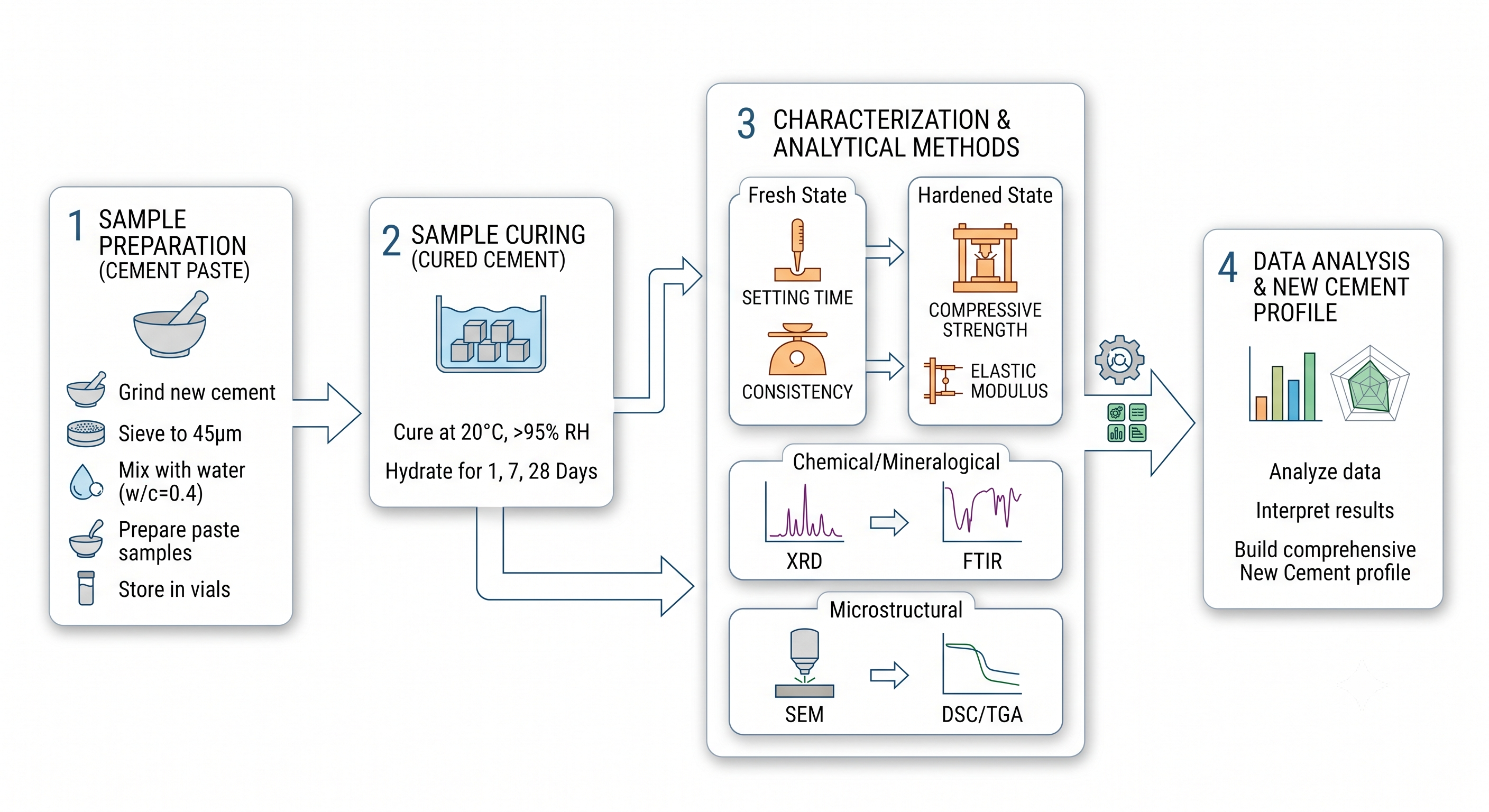
Some Tips...
- • Groups multi-variable testing under distinct procedural nodes.
- • Explicitly lists analytical metrics alongside experimental steps.
- • Ensures rapid comprehension for multi-stage lab routines.
Ilustrative Step-by-Step Preparation Process
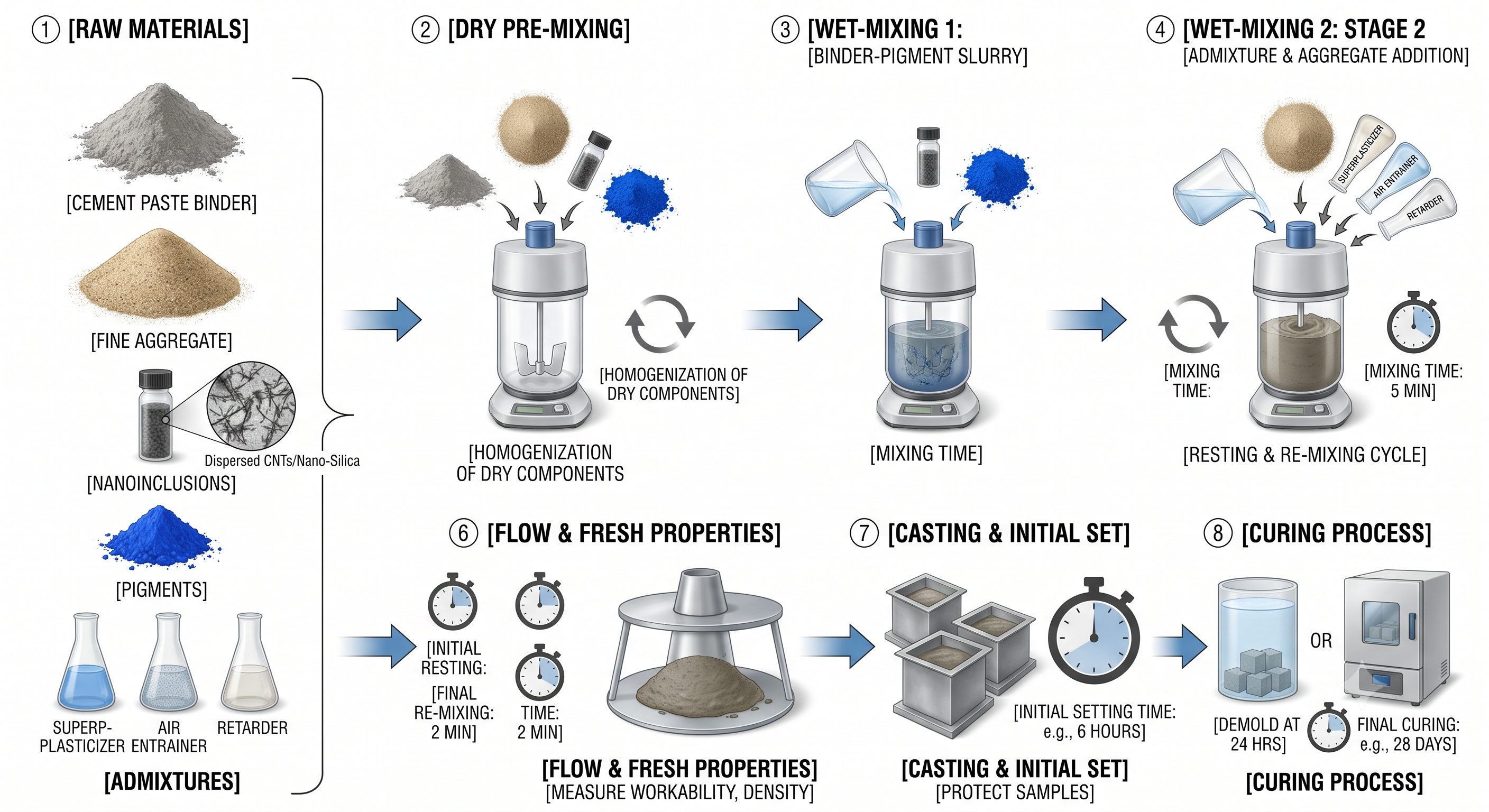
Some Tips...
- • Segregates acute, chronic, and estrogenicity bioassays effectively.
- • Integrates species names and exposure durations neatly.
- • High visual contrast allows effortless reading on large displays.
Classic Fluxogram
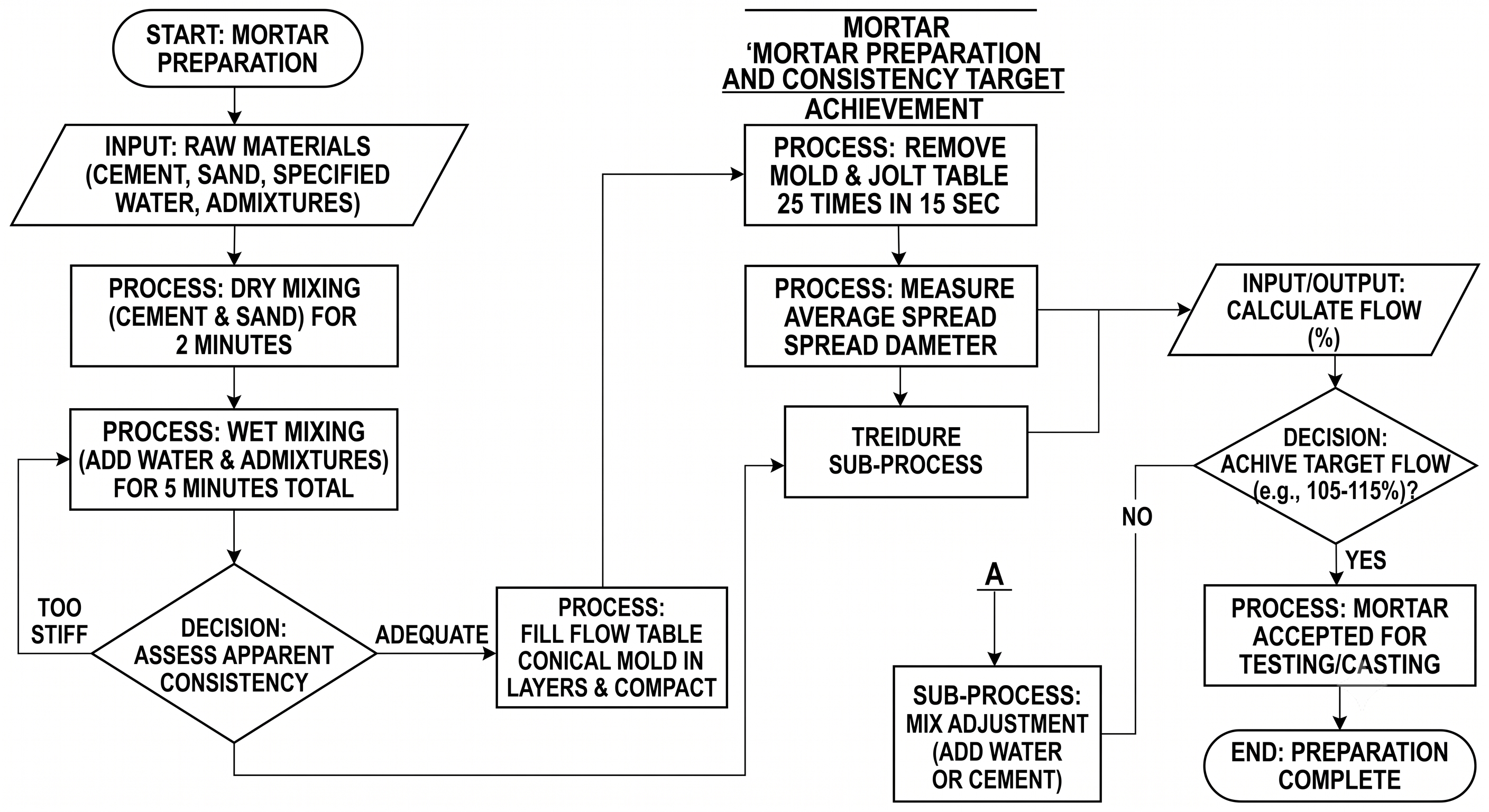
Some Tips...
- • Master-level research framework synthesizing all experimental branches.
- • Replaces lengthy text paragraphs with an elegant system flowchart.
- • Serves as the ultimate slide reference for dissertation defenses.
Presenting Tabular Data Effectively
Cognitive Rationale
Tables designed for academic papers serve archival completeness, whereas slides require instant cognitive comprehension.
- Avoid Screen Clutter: Unfiltered raw data forces viewers to read micro-text rather than listen to the speaker.
- Distance Legibility: Font sizes under 18pt are completely illegible from the back row of an auditorium.
- • 1. Filter Aggressively: Extract only key variables tied directly to the narrative.
- • 2. Simplify Units: Group metrics with clear, consistent dimensional units.
- • 3. Highlight Key Metrics: Use contrasting background fills or bolding for critical findings.
- • 4. Maximize Spacing: Ensure generous cell padding and high-contrast typography.
Anti-Pattern: Raw Paper Table Copy-Paste
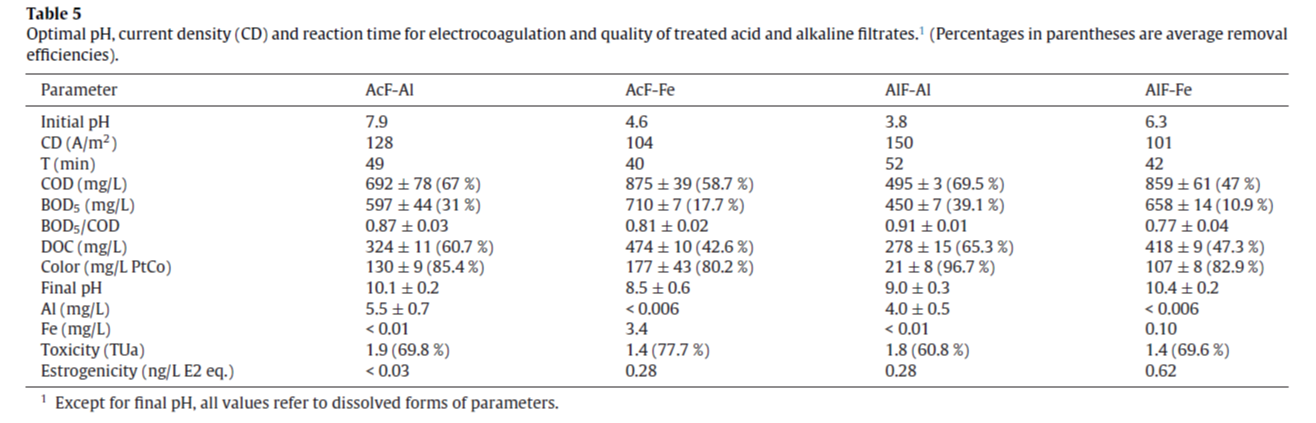
Why This Fails
- • Unreadable micro-fonts (<10pt) force audience squinting.
- • Excessive background noise (too many rows/columns).
- • Zero visual hierarchy or focus on key metrics.
- • High cognitive fatigue for the evaluator.
Key Deadlines, Scheduling & Defense Setup
2026-2 Semester Dates
- • 04-December-2026: Deadline for Project Defense (End of classes).
- • 22-December-2026: Last day to release final grades and concepts.
- • 15-January-2027: Last day to change incomplete grade concept "I".
Venue & Calendar Setup
- • Authorized Venues: DEC Meeting Room, LABENGE Meeting Room, LMC Class Room, LEN 121, or other room indicated by advisor.
- • Google Calendar: Schedule the event, inviting the defense board and secretaria.ppgec@ufv.br.
- • Online/Hybrid Mode: Must include meeting room link in the invitation.
- • IP Protection: If defense is restricted for IP protection, explicitly inform in description.
Evaluation & Submission
- Download form from the official PPGEC webpage.
- Fill in details & attribute score marks.
- Collect signatures from all committee members.
- Deliver directly to Course Coordinator Prof. José Maria Carvalho.
Research Phase, Concomitant Enrollment & Bond Maintenance
Research Execution
No traditional classroom load: Student duties consist purely of carrying out approved research activities under advisor supervision.
- Evaluated semi-annually as Satisfactory (S) or Unsatisfactory (N).
- No credit hours generated; does not impact overall GPA coefficient.
Preventing Dismissal
CIV 799 serves as the formal academic link maintaining active student enrollment status within PPGEC.
Mandatory Study Plan Action:
Concomitant Registration
Because CIV 799 represents active research continuity, it is structurally linked with key academic milestones and must be enrolled concomitantly with:
- CIV 797: Research Seminar
- Qualification Examination: Doctoral Requirement
Evaluation Criteria, Grading & Compulsory 'N' Rules
Advisor Evaluation Form
- Grading link is sent exclusively to the research advisor via official Google Form.
- The advisor submits the semester concept along with institutional reporting data for PPGEC annual statistics.
Milestone Dependencies
CIV 799 evaluation is directly dependent on deadline compliance and concept release in linked academic milestones:
Automatic Grade Propagation:
Compulsory Failure Rule
Regular program duration is monitored automatically
Compulsory "N" Grade Trigger:
- • 24 Months for Master's Degree
- • 48 Months for Doctorate Degree
Qualification Exam Regulations & Workflow
Deadline & Regulation
- Must be included in the Study Plan and completed up to the 6th academic semester (not measured in 36 months!).
- Strictly linked to the academic semester progress, following UFV Post-Graduate Regulations.
AcademicoPG & Calendar
Follows the exact same procedure as the Final Defense:
- • System Workflow: Committee registration and scheduling via AcademicoPG.
- • Approval Chain: Validation by Advisor $\rightarrow$ Coordinator $\rightarrow$ PPGEC Board.
- • Google Calendar: Create event inviting board members and secretaria.ppgec@ufv.br (include room location or link for hybrid/online).
Board Composition & Defense Requirements
Language & Publications
- Language Options: Manuscripts may be written and defended in English, Portuguese, or Spanish.
- M.Sc. Defense: Proof of at least 1 scientific article submitted.
- Ph.D. Defense: Proof of 2nd distinct submitted article + similarity report.
- AcademicoPG Final Manuscript Upload: Submission of the final version of the Dissertation/Thesis must be processed through the AcademicoPG system when scheduling the defense. (Note: This system upload procedure does NOT apply to Qualification Exams).
Examining Board Setup
- • M.Sc. Defense: Minimum 3 members (at least 1 external to PPGEC).
- • Ph.D. Qualification & Defense: Shared board requirements — minimum 5 members (at least 1 external to PPGEC and 1 external to UFV). More members may be included if necessary.
- • Substitute Members (Suplentes): Mandatory indication of 2 substitute members, with at least 1 external to UFV.
CAPES Best Practice
Rationale behind External Members:
Program Contacts & Official Channels


Official PPGEC Channels
Access our portal for regulations, forms, and defense agendas, or follow our social media networks: